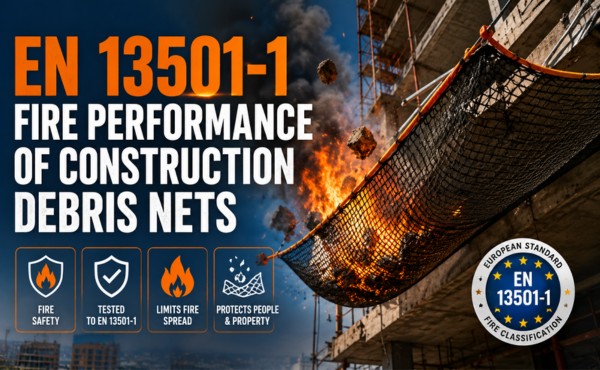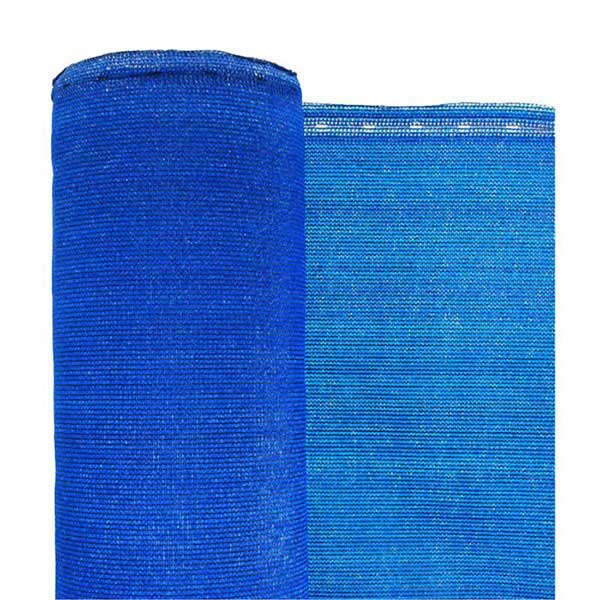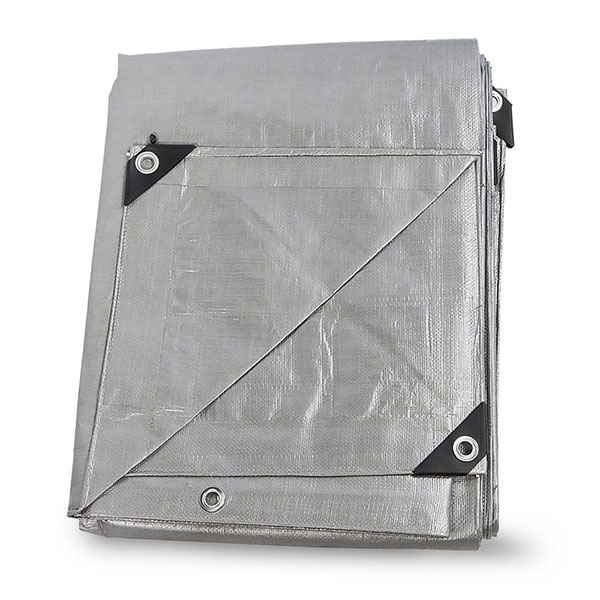
EN 13501-1 is the European standard for classifying the reaction-to-fire of construction products. For debris nets, the most important classes are the fire class (A1–F), smoke class (s1–s3), and flaming droplets class (d0–d2). The best achievable rating for a polymer debris net is B-s1,d0 — very limited fire contribution, low smoke, and no flaming droplets. Always request a laboratory test report before purchase; the word “fire retardant” alone is not proof of any EN 13501-1 rating.
What Is EN 13501-1 for Construction Debris Nets?
EN 13501-1 (Fire classification of construction products and building elements — Part 1: Classification using data from reaction to fire tests) is the primary European harmonised standard that defines how construction products are classified according to their reaction to fire. It is maintained by the European Committee for Standardisation (CEN) and underpins CE marking fire performance claims across EU and EEA member states.
Unlike some legacy national standards that tested only whether a material would ignite or spread flame, EN 13501-1 uses a three-part classification system that captures:
- Fire class — how much the material contributes to fire growth (A1 to F)
- Smoke class — how much smoke the material generates (s1 to s3)
- Flaming droplets/particles class — whether molten burning material falls from the product (d0 to d2)
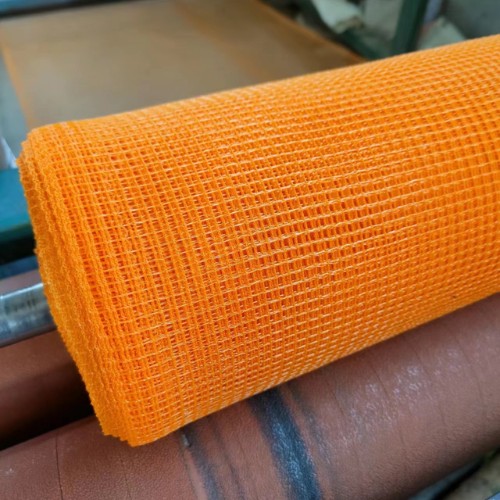
For construction debris nets — the knitted or woven polymer mesh screens used to contain debris, dust, and sparks during scaffold enclosure, facade renovation, and demolition — EN 13501-1 is the correct European fire classification reference. Many competitor product pages simply state “fire retardant” or cite US-market standards such as NFPA 701 without providing the actual EN 13501-1 classification. This guide explains exactly what those rating codes mean and how to verify them.
Key distinctionEN 13501-1 classifies reaction to fire — how a product behaves when exposed to fire. This is different from fire resistance (EN 13501-2), which rates how long a construction assembly withstands fire. Debris nets are always assessed under reaction to fire, not fire resistance.
Why Fire Performance Matters on Construction Sites
Construction debris nets are among the largest temporary textile products installed on a project site. A single high-rise scaffold enclosure can involve several thousand square metres of netting — directly adjacent to ignition sources, people, and flammable materials. Fire risks that make EN 13501-1 ratings relevant include:
| Site Scenario | Fire Ignition Risk | Why Rating Matters |
|---|---|---|
| Scaffold enclosures | Welding, cutting, grinding sparks | Sparks contact net directly; unrated HDPE ignites readily |
| Facade renovation | Hot-works cutting tools, heat guns | Net is in the immediate hot-works zone |
| Demolition sites | Gas cutting, torch work | Uncontrolled debris and ignition in confined areas |
| Urban / public-facing scaffolds | Arson, discarded cigarettes, external fire spread | Fire spread to public spaces; regulatory and liability risk |
| Enclosed facades & tunnels | Confined space traps smoke | s1 smoke rating critical for worker egress safety |
| Industrial maintenance | Plant fires, chemical flash | FR netting reduces secondary fire spread |
Beyond the physical risk, many EU national building regulations, site safety management plans, and insurance policies now require evidence of EN 13501-1 testing for temporary enclosure products on high-risk projects. Specifying and procuring to the correct classification protects workers, reduces liability, and satisfies regulatory audit.
EN 13501-1 Classification Explained
Main Reaction-to-Fire Classes: A1, A2, B, C, D, E, F
The fire class describes how significantly a product contributes to fire growth. The classes range from A1 (no contribution, non-combustible) through to F (no performance determined). Here is what each class means in practice for debris nets:
| Class | Description | Relevance to Polymer Debris Nets |
|---|---|---|
| A1 | Non-combustible, no contribution to fire at all | Not achievable — polymer nets are inherently combustible materials; A1 is for stone, glass, and mineral products |
| A2 | Non-combustible in bulk, very limited combustibility | Not achievable — requires extremely low heat of combustion; not applicable to HDPE or PP meshes |
| B | Very limited contribution to fire | Best achievable — the highest practical classification for FR-treated polymer debris nets; requires specialist FR formulation and third-party testing |
| C | Limited contribution to fire | Achievable — good FR performance; suitable for many site types when combined with s1 and d0 |
| D | Acceptable contribution to fire | Lower FR grade — adequate for some low-risk applications but not recommended near hot works |
| E | Acceptable behaviour under small flame attack only | Minimal FR — basic flame resistance only; avoid for hot-work zones and enclosed sites |
| F | No performance determined | Avoid — no fire testing; standard non-FR netting |
Why not A1 or A2?Debris nets are made from polymers — HDPE, polypropylene, or polyester — which are organic combustible materials by chemical definition. A1 and A2 are reserved for inorganic, essentially non-combustible products. The highest realistically achievable class for a polymer construction net isClass B.
Smoke Class: s1, s2, s3
The smoke classification indicates the volume and density of smoke produced when the product burns. This is a critical parameter for worker safety during emergency evacuation.
| Smoke Class | Meaning | Implication |
|---|---|---|
| s1 | Low smoke production | Preferred for enclosed sites, tunnels, and areas with workers; maximises visibility during evacuation |
| s2 | Medium smoke production | Acceptable in some outdoor applications; not recommended for enclosed or public-facing sites |
| s3 | High smoke production or not determined | Avoid where worker safety or public access is a concern; poorest performance class |
Flaming Droplets Class: d0, d1, d2
The flaming droplets and particles classification indicates whether burning molten material falls from the product. This is particularly important for debris nets because they are installed above workers, pedestrians, scaffolding platforms, and stored materials.
| Droplets Class | Meaning | Safety Implication |
|---|---|---|
| d0 | No flaming droplets or particles | Ideal — no secondary ignition risk from falling burning material below the net |
| d1 | No persistent flaming droplets | Droplets occur but self-extinguish within 10 seconds; lower secondary risk |
| d2 | Flaming droplets or particles present | Burning material falls; risk of secondary ignition to materials and injury to persons below |
Why d0 matters for overhead netsA debris net installed above a public walkway, a timber scaffold deck, or a roofing felt layer should be rated d0. Even a brief d1 or d2 event can cause secondary ignition of combustible materials below or inflict burns on people standing beneath the scaffold.
Common EN 13501-1 Ratings for Fire-Retardant Debris Nets
Most commercially available fire-retardant construction debris nets fall into one of the following classifications. Understanding what each combined rating means in practice helps buyers make the right selection for their specific site risk profile.
| Rating | Meaning | Best Use Case |
|---|---|---|
| B-s1,d0 | Very strong FR, low smoke, no flaming droplets | High-risk public, enclosed, or urban sites; hot-works zones; EU-specified projects |
| B-s1,d2 | Strong fire class, low smoke, droplets allowed | Some certified FR safety net products; not for uncontrolled overhead occupancy |
| C-s2,d0 | Moderate FR, medium smoke, no droplets | Lower-risk outdoor containment |
| C-s3,d0 | Moderate FR, high smoke, no droplets | Open-air temporary containment only; avoid in confined spaces |
| E / F | Limited or no verified FR performance | Avoid near hot works |
EN 13501-1 vs NFPA 701 vs ASTM E84 vs DIN 4102
One of the most significant knowledge gaps in the market is the conflation of different national and international fire standards. A supplier who quotes NFPA 701 compliance is not providing an EN 13501-1 classification. These are different test methods measuring different properties, and they are not interchangeable for EU project specifications or CE marking.
| Standard | Region | What It Measures | Smoke Class? | Droplets Class? | Relevance to EU Debris Nets |
|---|---|---|---|---|---|
| EN 13501-1 | EU / Europe | Reaction to fire of construction products — fire class, smoke class, and flaming droplets | Yes (s1–s3) | Yes (d0–d2) | The definitive standard for CE marking and EU project specification |
| NFPA 701 | USA | Flame propagation of textiles and films; vertical flame spread and after-flame time | No | No | Common in US specifications; not equivalent to EN 13501-1; does not cover smoke or droplets |
| ASTM E84 | USA | Surface burning characteristics — flame spread index and smoke developed index | Partial (smoke index) | No | Listed by some US-origin suppliers; not harmonised with EU requirements |
| DIN 4102 B1 | Germany | Flame-retardant classification for construction materials — “schwer entflammbar” (highly retardant) | Indirect | No | Historically used in Germany; many projects now require EN 13501-1 as the harmonised reference; sometimes paired with EN 13501-1 |
| BS 5867 | UK | Fabrics for curtains and drapes — flame retardancy of textiles | No | No | Not applicable to construction debris nets; occasionally misquoted |
The NFPA 701 trap: A product that passes NFPA 701 has demonstrated acceptable flame propagation resistance under that US test method. It has not been classified for smoke production (s class) or flaming droplets (d class). If your project specification, insurance policy, or client contract references EN 13501-1, NFPA 701 certification is not a substitute. Always ask for the EN 13501-1 test report specifically.
For projects in Germany, Austria, or Switzerland, DIN 4102 B1 may be contractually required alongside or instead of EN 13501-1. Where both are specified, ensure your supplier can provide test certificates for both standards — they are separate test procedures and a single product may need two separate laboratory reports.
What Test Documents Buyers Should Request
The words “fire retardant” or “FR” on a product data sheet carry no legal weight without supporting documentation. Before purchasing fire-rated construction debris nets for a specification-critical project, request all of the following from the supplier:
- EN 13501-1 Classification Report — the formal classification document issued by the notified laboratory, showing the full three-part rating (e.g. B-s1,d0). This is not the same as a test report — it is the output classification document.
- Underlying Test Reports — reference the specific test methods used, typically EN ISO 11925-2 (ignitability under single-flame attack) and EN 13823 (single burning item, SBI test). Ask which tests were conducted and under which conditions.
- Product Identification Match — confirm the product name, material specification (e.g. “black HDPE knitted debris net, 2.5mm yarn, 5mm × 5mm mesh”), weight (GSM), and colour on the certificate exactly matches what you are purchasing. Certificates are product-specific; a different colour, mesh size, or GSM requires a separate test.
- Net Weight, Mesh Size, and Roll Dimensions — the physical specification should match certificate data. Any deviation (e.g. lighter GSM to reduce cost) may invalidate the fire classification.
- FR Additive Type: Masterbatch or Surface Treatment? — FR additive incorporated into the polymer during extrusion (masterbatch) is significantly more durable than surface-applied FR coatings, which can wash off, be abraded away, or degrade under UV. Ask explicitly.
- Issuing Laboratory Name and Accreditation Number — the laboratory should be a recognised notified body or nationally accredited test facility. Certificates from non-accredited labs have no regulatory standing.
- Test Date and Certificate Validity — EN 13501-1 classifications do not expire per se, but product formulations can change. Check whether the certified product still matches current production, especially if the certificate is more than 3–5 years old.
- Outdoor / UV Exposure Qualification — confirm whether the FR performance has been evaluated after UV weathering, or whether the certificate applies to new material only. This is critical for nets left on site for extended periods.
- Declaration of Performance (DoP) — for CE-marked products under the Construction Products Regulation (CPR), the DoP references the harmonised standard and declared performance. Request this if the product is CE marked.
Procurement tip: Include a contractual clause requiring all fire performance documentation to be submitted for approval before delivery. A supplier who cannot provide an EN 13501-1 classification report — not just a product data sheet that mentions a rating — should be treated as unable to demonstrate compliance.
Fire-Retardant vs Standard Debris Netting
Not every construction project requires EN 13501-1-classified fire-retardant debris netting. Understanding the difference helps you specify correctly and avoid unnecessary cost — while ensuring FR netting is used where the risk genuinely demands it.
| Factor | Standard Debris Netting | EN 13501-1 FR Debris Netting |
|---|---|---|
| Ignition behaviour | Ignites readily; sustains flame; melts and drips | Resists ignition; self-extinguishes; limits flame spread |
| Smoke | High smoke output (s3 equivalent) | Low to medium smoke depending on class (s1–s2) |
| Flaming droplets | Burning molten material falls freely | d0: none; d1: brief; d2: some droplets |
| Hot-works suitability | Not suitable — welding/grinding sparks will ignite | Required — reduces risk of ignition from sparks |
| Cost | Lower material cost | Higher cost; justified by risk profile and specification requirement |
| Appropriate for | Low-risk outdoor containment; no ignition sources nearby | Hot-works zones; enclosed facades; public walkways; urban sites; industrial maintenance; regulatory-specified projects |
The decision to specify FR netting should be driven by a formal site-specific fire risk assessment rather than default practice. However, on most urban, industrial, and public-facing scaffold projects in Europe, fire-retardant debris netting with a minimum EN 13501-1 classification of B-s1,d0 or C-s1,d0 is best practice and increasingly mandated by principal contractors.
Material Factors That Affect Fire Performance
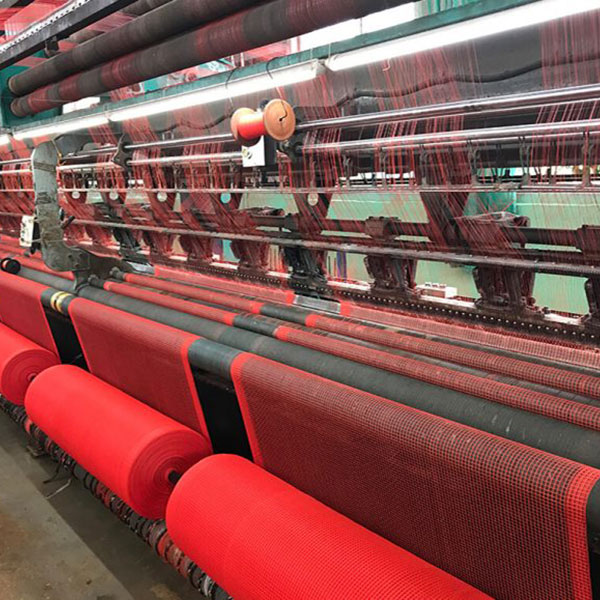
The EN 13501-1 fire classification of a debris net is not fixed by material alone — it is the result of the full combination of polymer type, FR additive, mesh structure, weight, colour, and weathering history. Here are the key factors:
Polymer Base Material
HDPE (high-density polyethylene) is the most common base for construction debris nets. Untreated HDPE is highly combustible. With appropriate FR masterbatch, HDPE nets can achieve B-s1,d0. Polypropylene behaves similarly to HDPE and can be FR-treated, though it tends to produce more flaming droplets in burning. Polyester (PET) has a higher natural char tendency and can achieve good FR performance when treated, but is less common for heavy-duty outdoor debris containment.
FR Additive: Masterbatch vs Surface Treatment
Masterbatch FR additives are incorporated into the polymer melt during yarn extrusion. The additive is distributed throughout the material, making performance consistent across the product’s life and resistant to UV degradation and washing. Surface-applied FR coatings (topical treatments) may provide acceptable initial test performance but can be abraded, washed away by rain, or broken down by UV exposure — significantly reducing fire performance on site over time. Always prefer masterbatch FR for outdoor construction applications.
Mesh Construction: Knitted vs Woven
Knitted nets (the majority of debris nets) have an open mesh structure that may allow easier air flow around burning strands, affecting flame spread rate. Woven nets with tighter construction can behave differently in fire testing. The EN 13501-1 classification is always net-specific — a certificate for a knitted net does not extend to a woven net of the same polymer.
GSM / Weight Per Square Metre
Heavier nets (higher GSM) contain more polymer mass per unit area. Changes in GSM affect the fire classification — a lighter version of an apparently identical net may not achieve the same EN 13501-1 class. Always confirm the GSM stated in the certificate matches the product being supplied.
Colour and Pigment
Pigments used to colour netting can affect fire performance. A certificate issued for a black HDPE net does not automatically apply to a green or white version of the same product, as pigment type and loading affects combustion behaviour. Where colour matters for specification, confirm the test certificate covers the specific colour being ordered.
UV Stabilisers and Weathering
UV stabilisers added to extend outdoor service life can interact with FR additives. Additionally, prolonged UV exposure can degrade FR effectiveness, particularly in surface-treated products. For nets left on site for more than one season, consider requiring proof of weathered fire performance or adopt a replacement cycle policy.
Application Guide: Where EN 13501-1 Fire-Rated Debris Nets Are Used
| Application | Minimum Recommended Class | Key Reason |
|---|---|---|
| Scaffold enclosure — hot works zone | B-s1,d0 | Direct spark exposure from welding, cutting, grinding |
| Facade renovation — enclosed scaffold | B-s1,d0 | Enclosed air space increases smoke risk; workers inside |
| Demolition containment — urban site | B-s1,d0 or C-s1,d0 | Public proximity; gas cutting operations |
| Bridge and infrastructure works | C-s1,d0 minimum | Debris over public traffic; traffic management zones |
| Industrial plant maintenance | B-s1,d0 | Flammable materials on site; process fire risk |
| Public walkway canopy | B-s1,d0 | Members of public directly below; liability and insurance |
| High-rise construction | B-s1,d0 | Fire spread across floors; emergency service access requirement |
| Tunnel and enclosed maintenance | B-s1,d0 | s1 smoke rating essential for evacuation safety |
| Low-risk outdoor perimeter | C-s2,d0 or above | Containment only; no ignition sources or public occupancy |
How to Choose the Right Fire-Rated Construction Debris Net
Follow this decision process to select the correct EN 13501-1-rated debris net for your project:
- Step 1 — Conduct a fire risk assessment. Identify ignition sources (hot works, arson risk, adjacent processes), proximity of people (workers, public), and the nature of materials below the net (timber, foam, chemicals). The risk level drives the minimum acceptable classification.
- Step 2 — Identify the required standard. Check your project specification, contractor requirements, local building regulations, and insurance conditions. Confirm whether EN 13501-1, DIN 4102, NFPA 701, or a combination is specified. For all EU projects, prioritise EN 13501-1.
- Step 3 — Select the target classification. For high-risk or public-facing sites, target B-s1,d0 as the minimum. For moderate-risk outdoor containment, C-s1,d0 or C-s2,d0 may be acceptable. Avoid d2 wherever persons are present below the net.
- Step 4 — Match mesh size and tensile strength to debris type. Fire rating is one dimension of specification. A net rated B-s1,d0 but with a mesh too large to catch fine debris, or too low a breaking load for heavy materials, is not fit for purpose. Specify both fire performance and physical performance requirements.
- Step 5 — Confirm UV and weather resistance. For extended installation periods, ensure the net specifies UV stabilisation and, if possible, confirm that fire performance has been evaluated post-weathering.
- Step 6 — Request and verify documentation before purchase. Do not accept delivery or install netting on a high-risk site until you have verified the EN 13501-1 classification certificate as described in Section 6 above.
- Step 7 — Implement an inspection and replacement policy. Fire-retardant performance is not permanent. Nets damaged by abrasion, long UV exposure, or hot-works damage should be inspected and replaced as part of the site’s fire and safety management plan.
Common Mistakes When Buying “Fire Retardant” Debris Nets
- Accepting “FR” or “Fire Retardant” without a test certificateMarketing language is not a fire classification. Any product can be labelled “FR” without independent verification. Always require an EN 13501-1 classification report from a notified laboratory.
- Confusing NFPA 701 with EN 13501-1These are entirely different standards. A product with NFPA 701 certification has not been classified for smoke class or flaming droplets class and does not satisfy an EN 13501-1 specification.
- Ignoring smoke and droplets ratingsPurchasing a “Class B” net without checking the s and d suffixes misses critical safety information. B-s3,d2 and B-s1,d0 are both “Class B” in fire terms, but represent dramatically different real-world safety outcomes.
- Buying indoor-only FR nets for outdoor useSome FR products are tested and certified for dry indoor conditions. UV, rain, and temperature cycling can degrade both the physical structure and the FR additive. Confirm outdoor applicability explicitly.
- Assuming all colours have the same fire ratingFire certificates are product-specific, including colour. A certificate for a black net does not cover a green or white net of the same mesh — the pigment chemistry changes combustion behaviour.
- Reusing aged or damaged nets without inspectionStored or previously-deployed nets may have degraded FR performance due to UV exposure, physical damage, or contamination. Never redeploy netting on a high-risk site without inspection and confirmation of continued FR performance.
- Ordering a different GSM than the certified productIf your supplier offers a “lighter, more economical” version of a certified net, check whether the lighter GSM is covered by the same EN 13501-1 certificate. It almost certainly is not.
FAQ
What does B-s1,d0 mean for debris netting?
B-s1,d0 is an EN 13501-1 classification describing three separate performance dimensions. B means very limited contribution to fire growth — the highest achievable class for a polymer product. s1 means low smoke production. d0 means no flaming droplets or particles were observed during testing. A debris net with this classification has been independently verified to resist ignition, limit flame spread, generate minimal smoke, and produce no burning molten material that could fall onto people or materials below.
Is EN 13501-1 required for scaffold debris nets in Europe?
EN 13501-1 is the harmonised European classification standard and is referenced in many EU national building regulations, safety management plan templates, and principal contractor specifications. While there is no single universal legal mandate requiring a specific class for all debris nets in all EU countries, high-risk projects involving hot works, public-facing scaffolds, or enclosed facades routinely specify a minimum class — typically B-s1,d0 or C-s1,d0 — as a contractual requirement. For any EU project where fire performance is specified, EN 13501-1 is the correct reference standard.
Is fire-retardant debris netting fireproof?
No. FR treatment slows ignition, limits flame spread, and may reduce smoke and droplets, but the material will eventually burn under prolonged or intense heat. FR netting is a risk-reduction and fire-management measure, not a barrier that prevents fire. It should always form part of a broader site fire management strategy, not be treated as a standalone protection measure.
What is the difference between flame retardant and fire resistant?
Flame retardant describes a material that has been treated or formulated to resist ignition and slow the spread of flame. The material can still burn but does so more slowly and may self-extinguish when the ignition source is removed. Construction debris nets are described as flame retardant. Fire resistant describes a construction element or assembly — such as a fire door or compartment wall — that is rated to maintain structural integrity and prevent fire passage for a defined period of 30, 60, or 120 minutes. Debris nets are polymer textiles and cannot be fire resistant in this sense.
Can HDPE debris netting pass EN 13501-1?
Yes. HDPE debris netting manufactured with FR masterbatch additives incorporated into the polymer during extrusion can achieve EN 13501-1 classifications including B-s1,d0. Standard HDPE without FR treatment will typically classify as E or F. The specific achievable class depends on the FR additive formulation, its loading level, yarn weight, and mesh construction — which is why independent laboratory testing and certification is essential rather than relying on supplier claims.
Does UV exposure reduce fire-retardant performance?
UV exposure can degrade fire-retardant performance, particularly for nets where FR additives are applied as a surface coating. Surface treatments are vulnerable to UV breakdown, rain washing, and physical abrasion. Masterbatch FR additives are generally more UV-stable because the additive is distributed throughout the polymer matrix rather than on the surface. For long-term outdoor installation, masterbatch FR should always be specified, UV stabiliser content should be confirmed, and regular physical inspection should be implemented.
Is NFPA 701 accepted instead of EN 13501-1 in Europe?
No. NFPA 701 is a US standard assessing flame propagation of textiles and films. It does not test for or classify smoke production or flaming droplets. In Europe, EN 13501-1 is the harmonised standard required for CE marking under the Construction Products Regulation. An NFPA 701 certificate alone cannot satisfy an EN 13501-1 specification. If a supplier offers only NFPA 701 documentation for a European project, the EN 13501-1 classification report must be requested explicitly. If they cannot provide it, the product has not been classified to the European standard.