Why Do Contractors Lose Bids Early?
Most contractors assume competitive pricing is the main factor in a lost bid. In practice, a significant portion of proposals are rejected during the initial technical review — before anyone looks at cost.
The reason is straightforward: when a proposal lists materials that do not meet the stated safety specifications, it fails the compliance check at the screening stage. No price advantage can recover from that.
Standard debris netting is one of the most common weak points. It is widely used across construction sites for containment and fall protection, but it is also flammable. On projects involving hot work — welding, grinding, cutting — or exposed electrical systems, flammable netting introduces a liability that project owners and consultants are no longer willing to accept.
This is the reason contractors are switching to fire retardant netting: not to perform better on site, but to remain eligible in the first place.
What Is Fire Retardant Netting
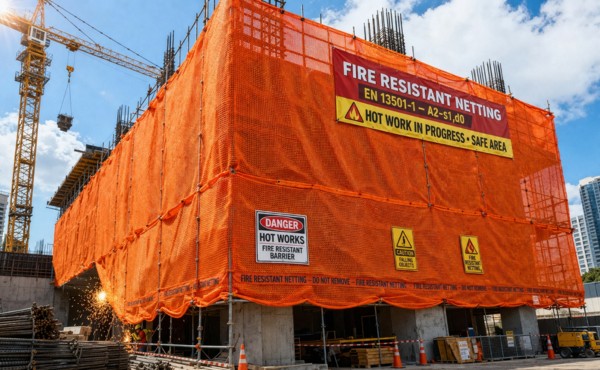
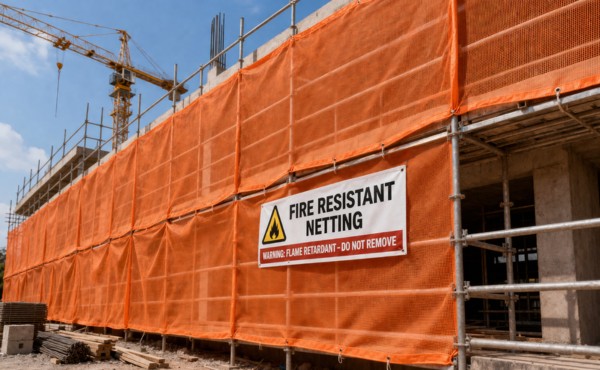
Fire retardant netting is engineered to resist ignition and limit the spread of flame. When an ignition source is removed, it self-extinguishes rather than continuing to burn. This behavior is the functional requirement that separates it from standard netting in a regulated construction context.
Standard polyethylene debris netting performs well for dust control and debris containment. However, it carries no fire-resistance treatment and does not meet fire safety specifications in projects where such requirements are written into the tender documents.
The practical distinction is not “better vs. worse” — it is “compliant vs. non-compliant.”
Standard Netting vs. Fire Retardant Netting:
| Feature | Standard Debris Netting | Fire Retardant Netting |
| Base material | Untreated polyethylene (HDPE) | Treated polyethylene or coated fibers |
| Flame behavior | Continues to burn after ignition | Self-extinguishes when source removed |
| Fire standard compliance | Does not meet NFPA 701 or equivalent | Meets NFPA 701 / BS 5867 / EN 13773 |
| Suitable for hot work areas | No | Yes |
| Suitable for regulated bids | Often disqualifying | Compliant baseline |
| Typical price premium | Baseline | 10–30% above standard netting |
| Buyer sensitivity to price difference | High | Low (tied to project eligibility) |
Is Fire Retardant Netting Required by Law?
Both apply, depending on the jurisdiction and project type. In many cases, fire retardant materials are required by the project specification rather than directly by statute — but the effect is the same: non-compliant materials are rejected.
The most widely referenced standard in construction netting is NFPA 701 (Standard Methods of Fire Tests for Flame Propagation of Textiles and Films), published by the National Fire Protection Association. Here is what contractors and distributors need to understand about it:
NFPA 701 defines a flame propagation test for flexible textiles and films. Materials that pass are classified as fire retardant for construction use.
There are two test methods. Test Method 1 applies to materials used in small-scale applications. Test Method 2 is for larger-scale assemblies, including scaffold and debris netting on construction sites.
A passing result means the material stops burning within a defined timeframe after the test flame is removed, and the char length and flame afterglow remain within the specified limits.
Products should carry documented test certificates from an accredited third-party laboratory. Suppliers claiming NFPA 701 compliance without test documentation should not be accepted in a regulated bid.
In the UK and EU, equivalent standards include BS 5867-2 and EN 13773. For international projects, the relevant standard is specified in the tender documents.
When fire retardant materials are listed in a specification, they are mandatory — not recommended. Substituting standard netting, even with a note in the proposal, is typically treated as non-compliance.
Which Projects Require Fire Retardant Netting?
Not every construction project specifies fire retardant netting. However, the requirement is common enough that treating it as a default selection in the following project categories is the practical approach:
Government-funded infrastructure and public buildings: Safety compliance is reviewed closely, and specifications are enforced as written.
Large commercial developments: Risk management requirements from project owners and their insurers frequently mandate fire-rated materials.
Healthcare, education, and hospitality construction: High-occupancy building types face stricter fire safety oversight throughout the build process.
Projects with significant hot work scope: Welding, grinding, and cutting near netting create direct ignition risk. Responsible project management specifies fire retardant materials regardless of whether it is explicitly required.
Renovation and retrofit work in occupied or partially occupied structures: Fire risk during construction is elevated when adjacent spaces remain in use.
If you are unsure whether a specific project requires fire retardant netting, the most reliable approach is to review the Preliminaries and General Requirements section of the tender documents. Requirements for fire-rated temporary protection are typically listed there.
Does Fire Retardant Netting Improve Bid Success Rates?
The impact operates at three points in the evaluation process:
1. Passing the technical compliance screen
Bids are screened for specification compliance before commercial evaluation begins. Fire retardant netting ensures your proposal clears this stage in projects where the requirement exists.
2. Reducing perceived risk in the eyes of the project owner
Fire incidents on construction sites carry significant financial and reputational consequences for the project owner — delays, damage claims, regulatory scrutiny. A contractor who proactively specifies compliant materials signals lower risk. In competitive bids where several proposals are technically acceptable, this perception influences final selection.
3. Strengthening the technical narrative
A proposal that references specific compliance standards (citing NFPA 701 compliance and providing test certificate references, for example) reads differently from one that lists generic material descriptions. It demonstrates that the contractor understands site conditions and has made considered material choices rather than defaulting to the cheapest available option.
Fire retardant netting does not guarantee a bid win. However, not using it on a project that requires it guarantees a loss.
Why Is Standard Netting No Longer Competitive?
The price advantage of standard debris netting — its traditional differentiator — is becoming irrelevant in bid contexts where compliance determines eligibility.
There are two market forces behind this shift. First, safety specifications in construction tenders have become more detailed and more consistently enforced. Project owners and their consultants have become more cautious about material selection, partly in response to high-profile fire incidents in the construction industry over the past decade. Second, the cost differential between standard and fire retardant netting, while real, is modest relative to overall project budgets. It does not present a meaningful saving when weighed against the risk of disqualification.
As a result, standard netting is losing ground not because it performs poorly, but because it no longer qualifies in a growing proportion of tender categories.
What Is the Opportunity for Distributors?
For distributors, the transition to fire retardant netting as a default specification creates a well-defined commercial opportunity — provided the sales approach matches the buyer’s actual concern.
Contractors who are actively bidding for projects are not primarily shopping for netting. They are trying to win work. A distributor who positions fire retardant netting as a bid strategy tool — rather than just a product upgrade — is addressing the real purchase motivation.
This changes the conversation in several ways:
Price objections become less relevant. When a contractor understands that the material is tied to project eligibility, the modest premium is no longer the main consideration.
Margin on fire retardant netting is typically stronger. The 10–30% price premium relative to standard netting translates to better margin per unit, and the buyer is less price-sensitive in this category than in commodity netting.
The advisory role builds longer-term relationships. A distributor who helps a client understand which projects require fire retardant materials — and ensures they are properly certified — becomes a resource in their bid preparation process, not just a supplier.
The value here is not the product in isolation. It is the role the product plays in helping the client win work.
What Should Buyers Look for When Sourcing?
Not all products marketed as fire retardant netting carry the same level of compliance documentation. Before specifying a product in a bid or purchase order, verify the following:
NFPA 701 test certificate: Confirm the product has been tested under Test Method 2 (for scaffold and debris netting) by an accredited third-party laboratory, and that the certificate is current.
Traceability to the tested product: The product you are purchasing should match the product described in the test certificate — same material composition, weight, and construction.
Treatment type: Some fire retardant netting uses surface coatings that degrade over time or after weathering. Ask your supplier whether the fire resistance is inherent to the fiber or applied as a coating, and what the product’s rated service life is under outdoor conditions.
Country or project-specific standards: For projects outside the United States, confirm whether the applicable standard is BS 5867, EN 13773, or another regional requirement, and ensure the product is tested to that standard.
Supplier documentation support: For regulated bids, you may need to include product compliance documentation in your proposal. Confirm the supplier can provide this in the required format.
Conclusion
Fire retardant netting has moved beyond its origins as a specialist product for high-risk environments. In a significant and growing range of construction project categories, it is now a baseline specification requirement.
For contractors, the implications are practical: proposals that do not meet fire safety material requirements are screened out before commercial evaluation, regardless of price. Upgrading to fire retardant netting — and documenting compliance correctly — is the minimum step required to remain competitive in these bid categories.
For distributors and suppliers, the shift represents an opportunity to move up the value chain. Helping clients navigate compliance requirements, understand relevant standards, and source properly certified products positions the supplier as a partner in bid strategy rather than a commodity materials vendor.
Material selection on a construction site is a technical decision. In project bidding, it is also a commercial one.